Usefulness of Learning Various Accounting Concepts in B-School
Sloan's core course Financing Accounting in the Fall Quarter is pretty heavy for folks with no prior accounting background.
Confession of a Stanford Sloan Fellow Series EP29
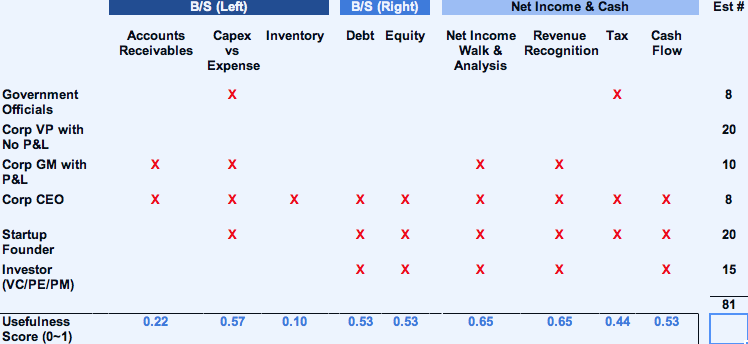
Sloan's core course Financing Accounting in the Fall Quarter is pretty heavy for folks with no prior accounting background. In an attempt to be more scientific about how useful is each particular accounting concept to different groups of Sloans with varying career aspirations, I classify 81 Sloans of Class of 2013 into 6 groups and highlight the accounting areas that are relevant for every group. As someone who's been working with accounting for 18 years, I do not feel every single accounting concept carries the same relevance or significance for every one. Based on the distribution of the class into different career groups and the related accounting areas for each group, I apply some simple array multiplification to calculate the relative "Usefulness Score" (ranging from 0 to 1) for each accounting concept. Hopefully this analysis will help my classmates better focus on the most critical domain areas that matter the most to them. Here's a brief walk-through:
Government Officials (except for Prime Minister or President): Understanding capex is key as this is where economic stimulus package comes from; Tax is always important being the biggest source of government income.
Corporate Vice President with No P&L Responsibility: Hmm.....it's blank! That's correct - no accounting concept is needed. Just follow the corporate rules laid out by your company's CFO and meet the budget.
Corporate GM with P&L Responsibility: Basically, only the left side of the balance sheet is relevant. The right side of the balance sheet (debt & equity) will be taken care of by the HQ. Revenue Recognition (aka "Rev Rec"), one of the most impactful and complicated accounting concepts, is of ultra-importance. Tax is not much of a concern as it'll be done by HQ's treasury guys. Cash Flow is not relevant as Corporate GMs/VPs use Net Income Walk for budgeting and performance measurement.
Corporate CEO: For this special breed of people, every accounting concept is relevant. Learn all of them while you still can. Many CEOs fall from grace because of their ignorance of basic financial/accounting concepts. You will rely on your CFO most of the time when it comes to financials, but a holistic understanding of all the major accounting concepts will help you make much more informed executive decisions (especially the ones that CFO can't make for you).
Startup Founder: Similar to Corporate CEO (which runs much bigger enterprise) but can afford to trim down a bit on Accounts Receivables and Inventory. Accounts Receivables becomes more of a major operational issue when your revenue exceeds $50MM. Inventory is relevant for manufacturing business that actually carries inventory. For most of the TMT startups in the Silicon Valley that make money from services, there is no much need to pursue a profound understanding of Inventory. Cash Flow is much more important than Net Income for the early-stage startups. You need to understand how Cash Flow works to keep the company float, and you need to understand how to work out Net Income to correctly calculate your company's pre-money valuation.
Investor (Venture Capital/Private Equity/Portfolio Manager/Angel): Things are only meaningful in relative sense. Of course having a CPA will help you tremendously as an investor, but if we have to pick the minimum necessary areas, I would only choose the right side of the balance sheet and net income/cash. If you really want to do a deep dive on the left side of the balance sheet, ask a Big Four firm to do some DD for you. It's advisable to master everything there is to know about equity and debt - this is where you play your games of financial alchemy.
So it seems that for the Sloan Class of 2013, the most important accounting concepts are:
Capex vs Expense, Debt, Equity, Net Income Walk & Analysis, Revenue Recognition, and Cash Flow.
Budgeting, a very important activity especially in large corporates, is not included in this matrix, because it's pretty much common sense. If you have a sales budget of 100, make your number at 101; if you have a cost budget of 100, spend your number at 99. That's all there is to it.
The detailed spreadsheet is here.